
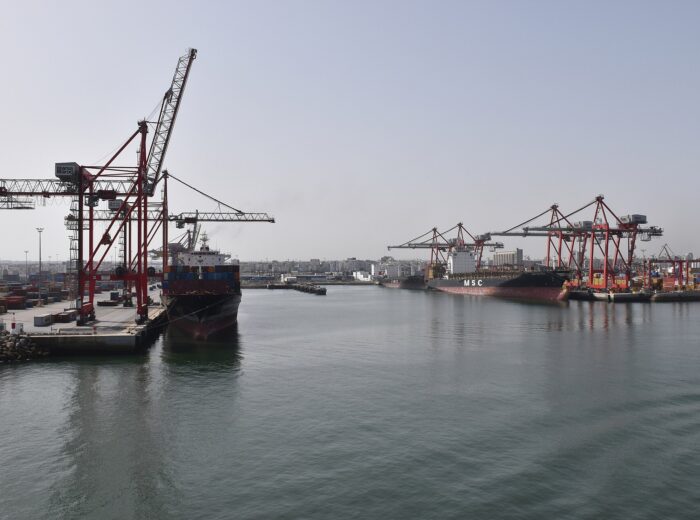
Morocco’s merchandise trade deficit widened by 25.4% year on year to 323.9 billion dirhams (about $32.3bn) in the first nine months of 2026, pushed up by a 37% jump in the country’s energy import bill, according to the November economic report of the Finance Ministry’s Directorate of Studies and Financial Forecasts (DEPF), released on Friday, November 27.
The monthly report, which compiles official data from across government, describes an economy supported by investment and household spending but increasingly strained on its external accounts, as higher oil prices linked to the conflict in the Middle East raise the cost of imported fuel.
Imports outpace exports
Imports rose 17% to 708 billion dirhams at the end of September, while exports grew 10.7% to 384.1 billion dirhams. As a result, exports covered 54.2% of imports, 3.1 percentage points less than a year earlier, according to figures from the report cited by Les Inspirations ÉCO and Morocco World News.
The energy bill reached 111.6 billion dirhams, or 15.8% of total imports against 13.5% a year before. Purchases of diesel and fuel oil rose 51%, mostly because of a 47.5% increase in prices, while volumes rose only 2.4%. Imports of raw materials climbed 60.9%, largely on a surge in purchases of crude sulphur used by the phosphate industry, and capital goods imports rose 22%.
On the export side, the automotive sector remained the largest earner at 132.1 billion dirhams, up 14.3% and accounting for about a third of total sales abroad. Agriculture and agri-food exports grew 10.7% to 72.4 billion dirhams, and aerospace exports rose 22.3% to 26.2 billion dirhams. Phosphate and derivative revenues were broadly flat at 74.7 billion dirhams despite a 17.4% fall in raw phosphate output.
Tourism and remittances cover less of the gap
Travel receipts increased 12.1% to 115.3 billion dirhams over the nine months, and remittances from Moroccans living abroad rose 11.3% to 103.1 billion dirhams. Together they covered 67.4% of the trade deficit, down from 75.7% a year earlier. The country welcomed 17.4 million tourists in the first ten months of the year, a 5% increase.
Foreign direct investment receipts rose 21.8% to 53.4 billion dirhams through September, with net inflows up 58.4% to 35.2 billion dirhams.
Budget deficit narrows, inflation picks up
Public finances moved in the opposite direction. The budget deficit fell by 13.6 billion dirhams, or 22.5%, to 46.7 billion dirhams at the end of October, as revenues grew 9.2% against a 4.3% rise in spending. Tax receipts were up 11.7%, with corporate income tax yielding 93.1 billion dirhams, a 25.7% increase, according to Les Inspirations ÉCO.
Consumer price inflation averaged 0.4% over the first ten months, but accelerated to 1.9% year on year in October. Bank lending grew 12.2% at the end of September, compared with 4.5% a year earlier, with loans to non-financial companies up 11.7%.
The labour market showed little improvement. Under the High Commission for Planning’s new labour force survey, the employment rate held at 37.4% in the third quarter, and unemployment under the strict definition rose 0.2 points to 10.5%. The female employment rate stood at 15%.
Industry remained the weak spot, with manufacturing value added down 2.3% in the first half, while the Casablanca Stock Exchange’s MASI index was down 12.2% since the start of the year at the end of October. Water reserves offered a brighter outlook for the new farming season: dams were 66.2% full on November 17, against 31.1% a year earlier.
Sources:
- Les Inspirations ÉCO: Conjoncture, la dynamique intérieure amortit les chocs extérieurs (DEPF note, November 27, 2026)
- Morocco World News: Morocco’s trade deficit widens 25.4%, energy import bill surges 37%
- Ministry of Economy and Finance, DEPF: Note de conjoncture No. 356, October 2026 (PDF)
Read more
 Iraq seeks higher OPEC quota as northern pipeline to Ceyhan restartsNovember 20, 2026
 Rising Middle East Tensions Push Inflation Higher in FranceAugust 1, 2026
 Shukran Tops Globally Known Brands among the world’s Muslim consumersJune 28, 2024
 Abu Dhabi remote business inspections rise 74.6% as service covers 14,884 firmsNovember 28, 2026