🤖 What happened?
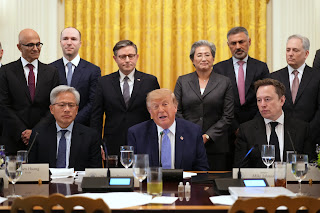
On September 29, 2026, Donald Trump and several major technology and AI companies announced a voluntary agreement aimed at improving AI safety and oversight.
Companies represented included major players such as OpenAI, Google, Meta, Anthropic, Nvidia and xAI.
The agreement involves measures such as:
- Internal safety assessments
- External evaluations of certain AI systems
- Greater oversight by company boards
- Measures to identify and manage risks associated with advanced AI systems
📝 What does “morally binding” mean?
This is the key phrase in the headline.
Trump was asked whether the agreement was legally binding. He described it instead as “morally binding.”
In other words:
Legally binding → companies are required by law to follow the rules and may face legal sanctions if they do not.
Morally binding → companies publicly commit themselves to following certain principles, but the agreement does not necessarily create the same legal obligations or penalties as legislation.
Trump also compared the agreement to a kind of “constitution” for the AI industry. (cbsnews.com)
⚖️ Why is this controversial?
The bigger debate is about who should control AI development.
There are two broad approaches:
1. Self-regulation
AI companies establish their own safety standards and voluntarily agree to follow them.
2. Government regulation
Governments create mandatory rules, testing requirements and potential penalties.
Trump has generally emphasized innovation and reducing regulatory barriers, arguing that excessive regulation could slow American AI development and weaken the U.S. position relative to China. (apnews.com)
Others argue that voluntary commitments may not be sufficient for highly capable AI systems and that certain safety requirements should be legally enforceable.
🌍 Why does this matter?
AI companies are investing enormous amounts of money in advanced models and computing infrastructure. At the same time, governments are trying to determine how to manage risks involving increasingly capable AI systems.
So the central question is:
Should AI companies primarily regulate themselves, or should governments impose mandatory safety rules?
The agreement announced under Trump represents an approach based largely on voluntary industry commitments, rather than relying exclusively on new legislation.
Read more
 UAE, Saudi Arabia lead digital economy in Arab regionSeptember 23, 2026
 Meta launches Muse AI agent in US with app integration for emails and paymentsSeptember 10, 2026
 French Tax Authority Hacked: Data from Hundreds of Thousands of Taxpayers May Have Been StolenAugust 14, 2026
 UAE Green Vision Takes Center Stage in Geneva: Advancing Global Green Value Infrastructure at WSIS Forum 2026 and AI for Good Global SummitJuly 10, 2026