
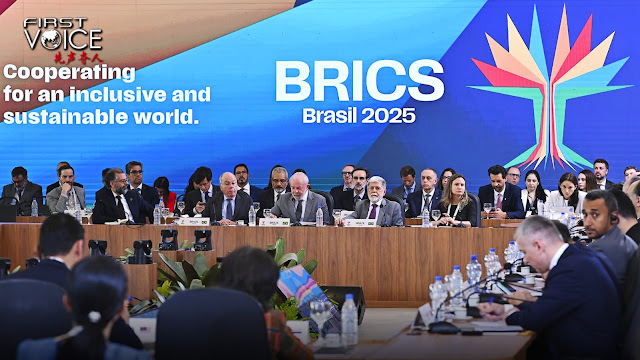
BRICS welcomed
its 11th member at the beginning of this year: The inclusion of Indonesia as
just another leader of Global South countries and the largest economy in the
Association of Southeast Asian Nations brings new weight to the appeal of the
bloc.
BRICS countries
are now home to roughly 3.3 billion people, i.e. over 40 percent of the global
population, while the BRICS economies account for an estimated 37.3 percent of
global gross domestic product based on purchasing power parity. In comparison,
the G7 economies account for roughly 28.4 percent.
In 2001, Goldman
Sachs economist Jim O’Neill published a game changing paper that detailed how
four emerging economies — Brazil, Russia, India and China — were set to reshape
the global economy in the coming years. Following that, the inaugural BRIC leaders
summit in Russia’s Yekaterinburg in 2009 declared: “The dialogue and
cooperation of the BRIC countries is conducive not only to serving common
interests of emerging market economies and developing countries, but also to
building a harmonious world of lasting peace and common prosperity.” In
many ways, the BRICS mechanism has been fulfilling that mission ever since.
Chinese
President Xi Jinping brought about the concept of “greater BRICS”
cooperation for the bloc in his remarks at last year’s leaders’ summit in
Kazan, Russia, when the bloc saw a major expansion of member nations. He
suggested the bloc embark on the task of building itself into “a primary
channel for strengthening solidarity and cooperation among Global South nations
and a vanguard for advancing global governance reform” by focusing on five
areas of work: security, innovation, green development, global governance and
people-to-people exchanges.
As Chinese
Premier Li Qiang is about to begin his trip to Rio de Janeiro for this year’s
leaders’ summit, the international community needs to be reminded that
“greater BRICS” cooperation is becoming more relevant for our world
today.
BRICS countries
have been seeking to establish a united front of emerging economy perspectives
in multilateral institutions and have tried to channel more support to these
economies, especially on critical new issues like climate and artificial
intelligence. In 2015 the bloc founded the New Development Bank, or NDB, a
multilateral development lender based in Shanghai, which has funded various
projects ranging from increasing liquified natural gas transportation capacity
in China to modernising freight rail systems in South Africa. In its ten years’
history, the NDB has approved loans for roughly 120 projects worth around 40
billion U.S. dollars.
Despite warnings
of a recession from economists, the world’s biggest economy is now celebrating
its own tariff spree while creating enormous uncertainty and a huge slide in
market confidence around the world. It is therefore even more urgent for BRICS
economies to step forward and enhance their push for multilateralism. And with
more funding for member country development projects in local currencies,
agencies like the NDB can bring useful and reliable supplements to the
precarious dollar system.
With more
members included and spread in more regions of the world, it is inevitable that
the BRICS mechanism, initially a global governance platform, takes on more
responsibilities, especially in the area of security. On the Ukraine crisis,
China, Brazil and other like-minded countries of the Global South formed in
2024 the “Friends for Peace” group to work towards ending the war in
Ukraine. The six-point consensus presented by China and Brazil on the Ukraine
crisis in the same year won support from dozens of Global South countries.
Adding to the
Ukraine crisis, the Israel-Hamas war is still ongoing while the Israel-Iran
ceasefire remains fragile. What makes things all the more tragic is that the
current international debate is scarcely focused on respecting a nation’s
sovereignty, nor on the millions of lost civilian lives during the wars. With
important regional stakeholders like Egypt, the UAE and Saudi Arabia in the
bloc, the BRICS mechanism should and can help bring more stability to Middle
Eastern security issues.
BRICS is
undoubtedly the most important platform for solidarity and cooperation among
emerging markets and developing countries in the world today. It is important
for multilateral organizations, such as BRICS, to evolve and reposition
themselves under the ever-changing global geopolitics. The world today calls
for “greater BRICS,” and by renewing its mission, the BRICS mechanism
will continue to thrive.
Read more
 Dozens of nations warn of Sudan famine as El Fasher marks a year under RSF controlNovember 1, 2026Aramco tells staff to leave Dhahran headquarters as Houthi attacks intensifyOctober 24, 2026
 Iran rules out moving enriched uranium abroad as talks with Washington stallOctober 21, 2026
 Iran summons UK ambassador, calls Fairford plot claim a “false flag”October 17, 2026